The lesson of St. Carlo: 'Make every moment matter'
A reflection on one short, beautiful life

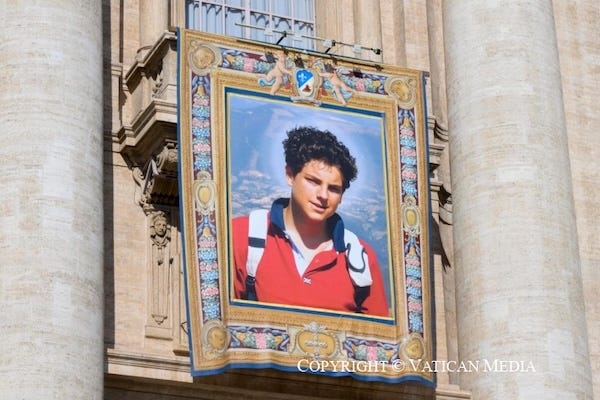
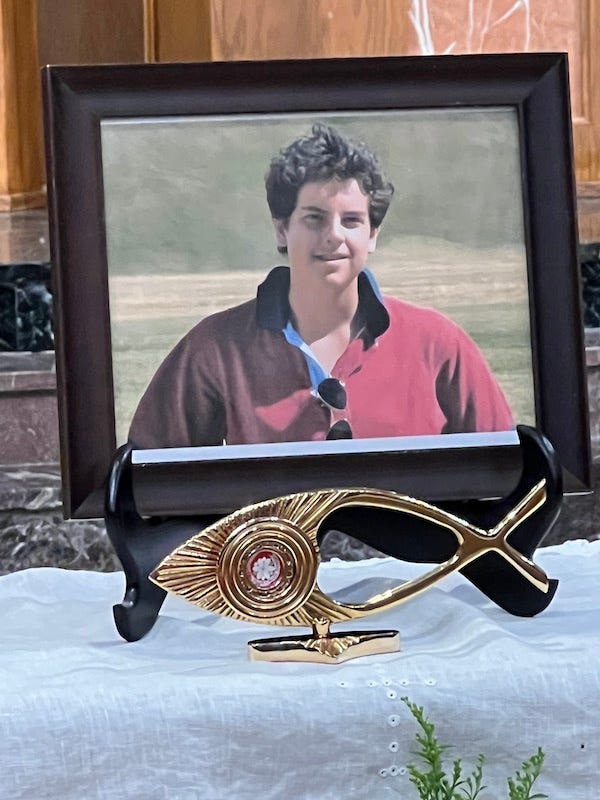
Three years ago, my parish in Queens hosted a relic of Blessed Carlo Acutis. As part of the event, we had an evening of Adoration and Benediction of the Blessed Sacrament, and veneration of the relic. Below are my remarks from that evening.
+
He was just a kid, from a small family.
His father was a businessman. His parents weren’t religious — his mother once said she’d only been to church three times before her son was born, for her baptism, her confirmation and her wedding. Her son liked to pray, but he didn’t write any great works of theology. He spent his days playing soccer, working on his computer, hanging out with his friends.
What was remarkable because he was so unremarkable.
Out of that, we come to realize: his greatest work, his legacy, was his life. His brief, beautiful, generous life.
This is the wonder of Carlo Acutis, Blessed Carlo Acutis. A boy who loved God and who loved God’s children.
A couple years ago a newspaper reporter interviewed a 24-year-old woman in Texas. The reporter asked, What was it that made Carlo Acutis so compelling to her?
She put it perfectly: “No visions, no tilma, no stigmata,” she said. “Just a dude and his computer and his love of God. That stuff’s cool.”
It’s cool because it’s real. It’s relatable. And it’s relevant.
The power of Blessed Carlo’s life is that he reminds our cynical world of something we easily forget: holiness isn’t just for a few.
It is for anyone.
Anyone can become a saint.
Even a teenager with a rugby shirt and sunglasses, with a mop of curly hair and a love for soccer and computers and Jesus.
Carlo grew up in northern Italy, and when he was a little boy his mother took him on long walks through their town. One of the places they visited was the local Catholic church. Carlo was mesmerized, as his mother told him about Jesus, and the Eucharist and Mary and the saints. As he got older, he became a regular visitor. He would bring flowers to Mary and sit in the back and pray.
When he was old enough, he begged his parents to let him have his First Communion. The parish priest agreed to let him receive the Eucharist a year early. After that, he went to Mass almost every day, just to receive Communion. “To always be close to Jesus,” he once said, “that is my life plan.”
That began a lifelong devotion to the Eucharist — which led him to his most famous achievement, a website he created devoted to Eucharistic miracles.
It’s been said that Carlo could be a saint for our age, the first saint of the millennial generation. But I think he speaks to us now in one way we might not expect.
Long before we started watching the Mass on livestream, Carlo found a way to use technology to bring Christ in the Eucharist into people’s homes. He made the miracle of Christ’s Real Presence present in a world of smartphones, tablets and laptops. He understood you could reach people that way. The mystery of the Eucharist, he realized, could be as close as your iPhone.
It’s one of the reasons Father Passenant wanted us to have this evening centered around the Blessed Sacrament. This is what Carlo loved the most — it’s WHO he loved the most. “By standing before the Eucharistic Christ,” Carlo said, “we become holy.”
That steadfast devotion, that simple but profound truth, is part of his legacy to us.
His other great legacy, I think, is the legacy of his heart.
I mentioned this yesterday when I spoke to the children from our academy: Carlo was a friend to people who felt they didn’t have friends.
He looked out for kids who were bullied. Kids who were disabled. Kids who came from broken homes.
If someone in his class had parents who were divorced, he would invite the classmate to his house for dinner.
He saved up his allowance to buy food for the homeless he passed on the street. He even organized some of his schoolmates to bring them blankets in the winter.
Writing about Carlo, Pope Francis said, the “15-year-old boy in love with the Eucharist” did not “settle into comfortable inaction, but grasped the needs of his time because in the weakest he saw the face of Christ. His witness indicates to today’s young people that true happiness is found by putting God first and serving Him in our brothers and sisters, especially the least.”
Carlo once asked his mother if he should become a priest. She said, “God will reveal what he wants you to be.”
It was revealed in the fall of 2006. A lot of kids in Carlo’s class came down with the flu. They eventually got better. But Carlo didn’t.
His parents took him to the doctor who ordered a number of tests that confirmed what no one wanted to hear: Carlo had an aggressive form of leukemia.
It moved quickly. After the diagnosis, as Carlo realized his life was coming to an end, he told his parents he wanted to offer his suffering for the church and the pope, adding, “There are people who suffer much more than me.” He saw the end of his life as a beginning. “In the Incarnation of Jesus,” he said, “death becomes life. In eternal life, something extraordinary awaits us.” He entered eternal life on October 12, 2006.
“God will reveal what he wants you to be,” his mother said.
I think God wanted him to be a hero. A friend. A role model.
A saint.
A saint who is very much one for our times.
As that Texas woman said: No visions. No stigmata. No tilma. But extraordinary devotion and love.
When Carlo died, there was a massive turnout for his funeral. His parents were overwhelmed. Some of the people who had come were not just classmates or neighbors or teachers. They were the homeless. The hungry. The beggars he had helped feed.
Carlo had remembered them. They came to let him know they remembered him.
This evening, I ask you: remember him. Remember his life and his lessons. Tell his story. Share his legacy. Make it matter.
The world needs more Blessed Carlos.
It needs more saints.
The beautiful moral of his life is that every one of us has that possibility within us. Enlivened by God’s grace, fortified by the Eucharist, inspired by models of holiness like Carlo Acutis, every one of us can rise to be something more.
Tonight, we have this blessed opportunity to remember that.
In a world tormented by pandemic and anxiety and war, Carlo gives us an urgent message for our times. His short life can serve as a parable of sacrifice and love — and a call to make every moment matter.
“Every minute that passes,” he once said, “is one minute less to become like God.”
With the Eucharist before us, may we seek like Carlo to fill the minutes of our lives with purpose, with prayer, with joy and with the love of Christ.